Between the Last Post and the Lychgate: Photographing Remembrance Without Taking Over
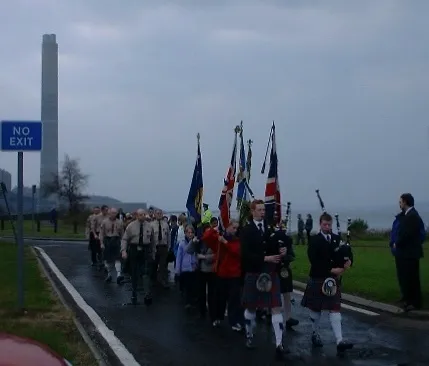
Photo: Thomas Nugent , CC BY-SA 2.0, via Wikimedia Commons
Every November, village high streets and town squares fill with wool coats, poppies and the particular hush of a crowd that has agreed to be quiet together. The camera is welcome at many of these services. It is not always welcome in the same way at every point in the morning. Learning the difference is most of the job.
Remembrance Sunday is not a photo opportunity with a marching band attached. It is a public act of remembering, and the photographer is a guest at it. That does not mean there should be no photographs. Local records matter. The way a high street looks when the wreaths are laid, the faces of people who have come out in the cold, the bugler under the lychgate: these are part of a town's memory. But the camera has to know when to be small.
The silence is not a shutter speed
During the two-minute silence, the camera goes down. Not because a photograph could not be made, but because making one would change the room. The Last Post is not a soundtrack. The silence is not a backdrop. If you are working at a service, decide in advance that you will not shoot during the silence, the act of remembrance, or the prayers. Stand still. Look at the ground or the wreaths. Let the moment belong to the people who came for it.
The same applies to the most raw moments around the cenotaph. A veteran who is crying is not a composition. A child who is confused about why everyone is standing still is not a cute detail. If you would not want the photograph taken of yourself in that moment, do not take it of someone else.
Stand where you are expected to stand
Before the service, speak to the organiser. Ask where the press or the official photographer is allowed to stand. Ask whether there is a family who has asked not to be photographed. Ask where the parade will turn. These are not boring questions. They are the difference between being present and being in the way.
Generally, the pavement is your friend. Stand behind the rope, behind the crowd, at the edge of the green. Do not walk into the road during the march. Do not stand in front of the war memorial while wreaths are being laid. Do not use a flash. Do not climb on a wall to get a better angle. A photograph taken from slightly too far away is almost always better than one taken from a place you should not have been.
Low winter light is part of the story
November light is thin and blue and gone by half past three. That is not a problem to be solved with a flash. It is the atmosphere of the day. Expose for the faces where you can, let the sky blow out if it must, and accept that some frames will be soft or grainy. A little grain suits a morning that is about endurance and memory.
We tend to use a longer lens and stay back. The compression helps in a crowd: hands holding poppies, a wreath being adjusted, the brass of a bugle against a grey coat. We look for details that do not intrude: the order of service in a gloved hand, a row of medals, a child's school shoes on wet pavement. These are quieter photographs, and they often last longer.
The frames between the official moments
The most respectful photographs are often taken between the things that are meant to be photographed. The handshake after the wreath is laid. A veteran adjusting another veteran's beret. The bugler lowering the instrument and letting out a breath. A teenager in a cadet uniform trying not to look cold. The tea urn in the church hall afterwards. These are not the ceremonial centre of the day, but they are the human edges of it.
That is where the camera can do something useful without taking anything away. The official moment belongs to the parade. The between-moments belong to the people. If you are patient, and you keep your distance, you will see them.
Crowds, consent and the local record
In a crowd, it is not always possible to ask everyone. Use judgement. If a photograph is going to be published, be careful with close-up images of identifiable people in distress. If you are working for a local paper or a community group, follow their policy. If you are an individual photographer, ask yourself whether the image is adding to the record or simply using someone's grief as colour.
We also edit with restraint. No heavy filters. No dramatic black and white that turns a real morning into a mood board. Caption things accurately. Name the church, the town, the year. A photograph without a caption becomes a generic poppy image. A photograph with one becomes a piece of local history.
What the day asks of us
Remembrance is a public ritual, but it is made of private feelings. The photographer's job is not to get the best seat or the most emotional frame. It is to make a record that the town can look at later without feeling that something was taken from it. Stand back. Wait. Put the camera down when it matters. Then pick it up for the handshake, the tea, the walk back to the car. That is where the day usually lives.