The Frames You Almost Deleted: Why One Contact Sheet Beats Four Hundred Files
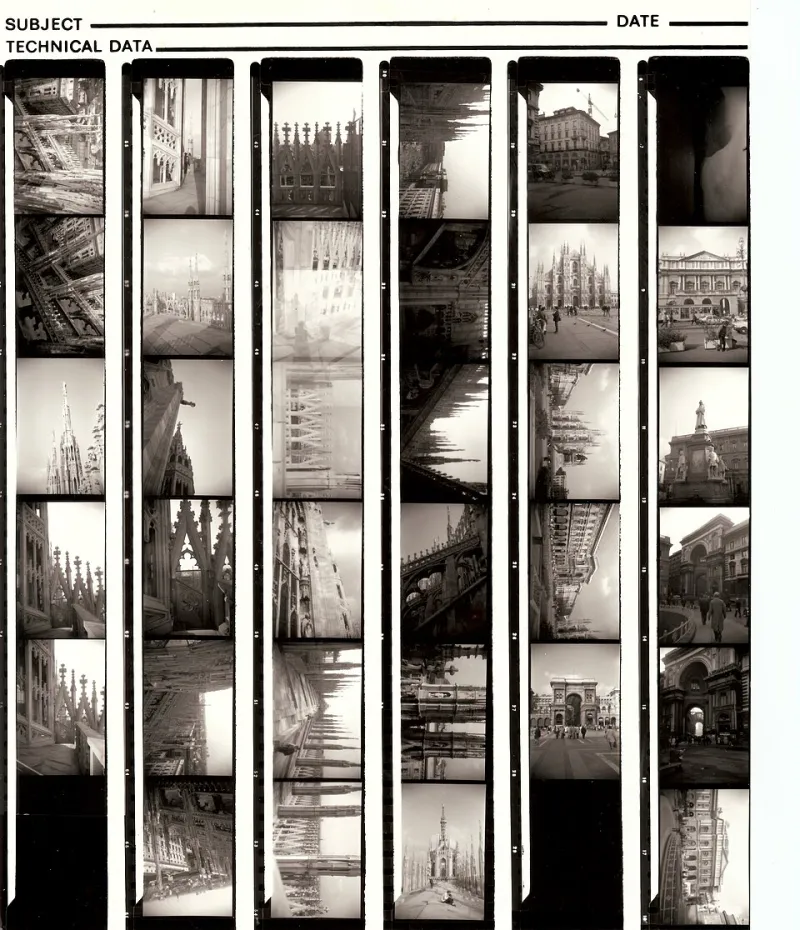
Photo: Infrogmation, CC BY-SA 4.0, via Wikimedia Commons
Somewhere in the studio there is a box of old contact sheets. They are not precious. They are working documents: 36 frames to a page, numbers down the side, a few frames ringed in red chinagraph pencil. A contact sheet was never the final print. It was the argument for the final print.
We have been thinking about that box a lot lately, because family photography has become very good at giving people too much. A shoot can produce six hundred images in an afternoon. They arrive in a gallery link, sorted by time, and the family is left to do the editing themselves. That is not a delivery. That is homework.
The Tyranny of the Nearly Good
When you photograph a family, you do not take six hundred different pictures. You take twenty or thirty pictures, repeated with slight variations. The same group on the sofa. The same child at the kitchen table. The same grandparents in the conservatory, one of whom has blinked in every third frame. The near-identical images pile up, and the family is told to choose.
Most people cannot choose. Not because they are indecisive, but because the differences are tiny and emotional. They pick the one where everyone is looking at the camera, because that feels like the correct answer. They leave behind the one where Dad is mid-sentence and Mum is laughing at something outside the frame. And that second picture is often the one that actually looks like them.
What the In-Between Frames Know
A contact sheet makes room for the in-between. The almost-smile. The blink. The hand reaching for a biscuit. The child who has turned away because a dog has walked past the window. The frame that is technically soft because someone moved, but emotionally sharp because that movement was the point.
We are not arguing for delivering bad photographs. We are arguing for showing the honest ones. There is a difference between a picture that is badly made and a picture that is not performing. A family does not need a set of images where everyone is at their most camera-ready. They need a set where they can recognise themselves. That usually includes a few frames where nobody is ready at all.
A technical near-miss can also be a useful kind of truth. The slightly blurred frame of a toddler running at the edge of the garden says more about that afternoon than the perfectly focused portrait taken five minutes later. The frame where the dog has walked into the shot is not a mistake. It is a fact of the household.
A Simple Contact Sheet Workflow
At Cottage Road Studios we use a simple process when a family wants a contact sheet rather than a full gallery.
First, we edit down to 36 frames. Not because 36 is magic, but because it is one roll of film and it forces a decision. We are not pretending digital is film. We are borrowing its discipline. The first pass is ruthless: no duplicates, no frames that only exist because the shutter was still going. The second pass is generous: we keep one almost-smile, one in-between, and one frame that might make the family ask why on earth we included it.
Second, we sequence the sheet. A contact sheet is not a random grid. It should read like the afternoon: arrival, kitchen, garden, the bit where everyone got cold, the goodbye. We number the frames and add a simple caption line at the bottom of the page. No logos over faces. No heavy borders. The sheet should feel like a document, not a menu.
Third, we present it twice. Once as a PDF for the phone, and once as an A3 print. The print matters. A contact sheet on a screen is a gallery. A contact sheet on paper is a conversation. Families gather round it in a way they do not gather round a folder of JPEGs.
Finally, we talk it through. We ask which frame they would have deleted. We ask which one they keep coming back to. That conversation often tells us more about the family than the shoot did. It also gives them permission to like the frame with the blink.
The Sheet as a Conversation
A contact sheet is not a cheaper delivery. It is a different one. It says: here is the day, in order, at a size you can hold. Here are the frames that worked and a few that almost did. Here is the story before we started polishing it.
Most families do not need four hundred photographs. They need a way to remember a Tuesday in November when the light was poor and the dog would not sit still and someone put the kettle on at exactly the right moment. A single sheet can do that. It can hold the almost-smile, the blink and the breath between poses. And it can remind them that the best picture was never the one where everyone was ready.