Two Days, One Kitchen: What a 48-Hour Food Brand Shoot Actually Looks Like
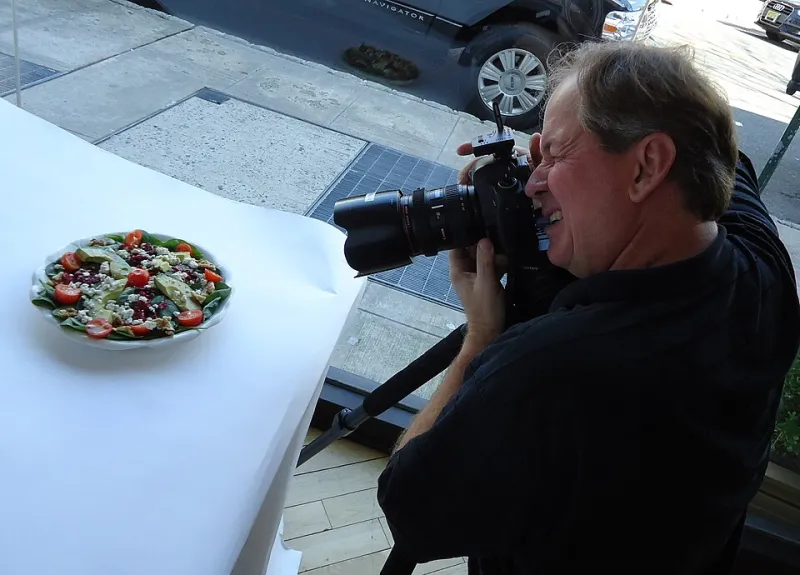
Photo: Tomwsulcer, CC0, via Wikimedia Commons
The brief arrived on a Tuesday: a small preserve and condiment brand, six products, a website refresh, and a social calendar that needed feeding until spring. Budget was modest. Studio time was out. The founder wanted the pictures taken in her own kitchen, which is about nine feet by eleven and has one window.
I said yes before I'd finished reading, because a real kitchen is almost always more interesting than a white cyclorama. Here's how the two days went.
Ten days out: the planning call
The first call was forty minutes and mostly not about photography. We needed three things settled before anyone picked up a camera:
The story in one sentence. Hers was that everything gets made in that room, on that hob, in batches small enough that she still stirs them herself. That sentence dictated the whole shot list — hands, steam, jars on the counter, the slightly chaotic shelf of spices above the kettle.
The honest list of what's needed. Not 'some nice pictures' but: twelve hero images for the site, eight verticals for social, six square product shots, three texture close-ups, and a short bank of b-roll. Naming the numbers stops day two from becoming a panicked scramble.
What we'd shoot on and what we'd move. I asked for a phone walkaround video of the kitchen, then marked up screenshots: this corner cleared, that shelf left exactly as it is, the bin relocated. Founders often offer to gut the room. Don't let them. You want it tidier, not unfamiliar.
Day one, 8.15am: everything through the front door
Kit for a job like this is deliberately small: one camera, a 35mm, a 50mm, a macro for texture, a tripod, one battery-powered strobe with a small softbox, two collapsible bounces, a grey card, and a roll of gaffer tape. All of it went in through the front door in two trips. That's the point. A big crew in a small room is just a crowd.
The first hour was spent not shooting. Window cleaned, surfaces cleared, one shelf rearranged by about four inches because a jar was catching the light badly. A second pair of hands (mine, in this case, borrowed from a friend who does props) wiped condensation off the jars roughly nine hundred times over the two days. That job alone is worth having someone for.
Lighting a room the size of a parking space
Here's the thing nobody says loudly enough: a small room with a decent window is easier to light than a big one. Light bounces off everything. There's nowhere for it to hide.
Our main source was the window — south-west facing, so it gave us strong raking light from about half nine until early afternoon. The strobe was only ever used as a gentle fill, bounced into the ceiling or into a white board held by the props person at roughly chest height. We never once pointed a bare light at a jar.
The problems were all practical rather than technical:
- The window light moved. By 1pm the best spot had shifted a foot to the left, so we shot the same hero setup in two blocks, before and after lunch, rather than trying to chase it mid-morning.
- Steam doesn't read. A freshly filled jar looks like a jar. We ended up shooting the pour last on both days, because it trashes the counter and needs a kettle boiled roughly every four minutes.
- The fridge hummed into the audio. Fine for stills, annoying for the two clips we wanted. We unplugged it for ninety seconds at a time and plugged it straight back in.
- The cat worked the room. Genuinely useful for one shot, catastrophic for the rest. The door stayed shut after that.
Directing people who have never been directed
The founder was in maybe half the frames. She is not a model, she said so repeatedly, and she was right. But she's brilliant in front of a camera when she's doing something, and hopeless when she's asked to look at it.
So we never asked her to pose. We asked her to ladle, to label, to check a thermometer, to carry a crate to the window because the light was better there. Verbs, not positions. The frames we ended up using most are the ones where she's mid-action and slightly annoyed about it — a face with an actual thought behind it.
One small trick worth stealing: give the person a job that takes longer than the shot. Ask them to count jars out loud, or to describe what they're doing to someone off-camera. The hands settle, the shoulders drop, and the expression stops being about being photographed.
Day two: the boring list, then the good stuff
Day two started with the list nobody enjoys — the matching product shots, same angle, same distance, consistent background, so the range looks like a range on a website. Forty minutes, tripod, grey card, done. Those images will never win an award and they'll be the ones used most often.
After that we loosened up. Crumpled greaseproof paper, a knife with a smear on it, a jar photographed in the doorway with the hallway dark behind it. The last shot of the day was taken at about twenty past three, when the light outside had gone blue and the kitchen lamp was on, and it's the one the founder picked as her new homepage banner.
What landed in her inbox
Three working days after wrap: 47 selects, retouched and cropped to the agreed ratios, plus a separate delivery of unedited b-roll and a small pack of texture frames for use as backgrounds. Everything was shot on the same kitchen surface, so the set looks like a season rather than a series of unrelated commissions.
Total time in the room: fourteen hours. Total time in a studio: none.
If you're booking your first shoot
A few things I'd tell any founder before they hand over a deposit:
- Don't apologise for your space. The chips in the worktop are doing more for your credibility than any studio set will.
- Book two half-days, not one long one. Brains and light both fail in the afternoon.
- Bring a list of must-haves and a list of wants. The first list gets shot in the first three hours, whatever happens.
- Have the packaging and label files ready so colours can be matched properly in the edit.
- Say out loud how the images will actually be used. Website hero and Instagram Story are not the same crop, and finding that out after the fact is how reshoots happen.
There's a persistent idea that credible brand photography requires a hired space, a stylist and a lot of white paint. In my experience the opposite is closer to the truth. Polished rooms photograph beautifully and say almost nothing. A slightly cramped kitchen with a good window and someone who genuinely cares about what's in the pan will do the work for you — as long as you clean the glass and keep the cat out.