Plot 14, Half Past Seven: Notes From a Family Shoot Among the Runner Beans
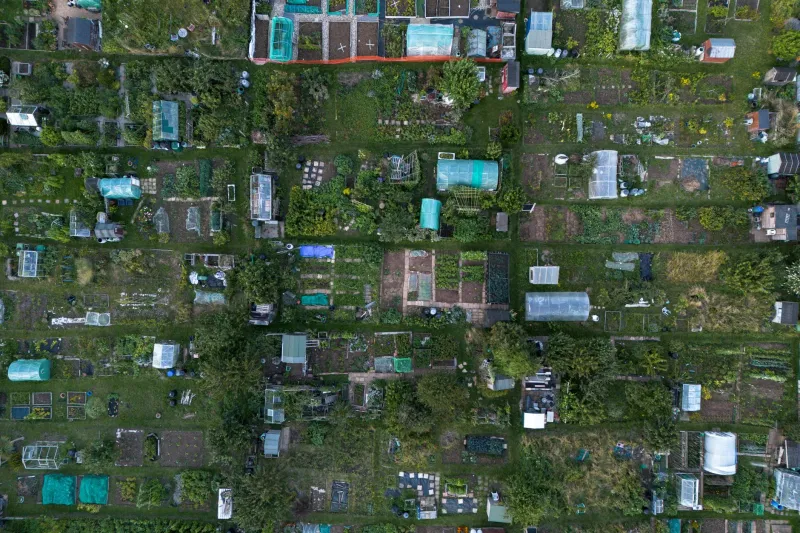
The site secretary handed us a key on a bit of baler twine and pointed up the hill. 'Plot 14. Mind the gooseberry, it's got a temper.' That was the whole safety briefing. Ten minutes later we were standing in a shed doorway the size of a phone box, waiting for the fog on the lens to clear, while a family of four tried to remember how to stand near each other without a dog or a screen in between them.
This is the fourth allotment shoot we've done for Cottage Road Studios and it has quietly become my favourite kind of family session. Not because the plots are prettier than a studio — they aren't, objectively — but because nothing about them is pretending. A backdrop is a decision someone made. A compost bin is a fact.
Why the gate is the hard bit
Allotment sites are strange, half-private places. There's a padlock, a code, a noticeboard with a laminated rota and a sign about not nicking the rhubarb. Families arrive slightly apologetic, as if they're sneaking us into a members' club. That nervousness is worth naming early, because it's the first thing that has to go.
Our approach is to spend the first fifteen minutes doing nothing photographic at all. We walk the plot. We look at what's actually growing, we ask whose shed that is, we get told about the bloke on Plot 9 who has strong opinions about courgettes. By the time the camera comes out, everyone has stopped performing 'being photographed' and started just being on their plot.
If you're a photographer reading this: resist the urge to start shooting while they're still in their 'we've arrived' posture. It never survives the edit anyway.
The light is doing something you can't fake
Half past seven on a late-August morning is the sweet spot on most UK sites. The sun comes in low over the hedges, the sheds throw long shadows, and the whole plot looks like it's been lit by someone who knows what they're doing.
But allotments are also a nightmare of contrast. You've got deep shade under the fruit cage, blazing light across the brassicas, and a greenhouse acting as a mirror. Practically, that means:
- Find your open shade first. The north side of a shed, or the shaded path between two plots, gives you soft, even light that flatters faces and doesn't blow out the whites of a t-shirt.
- Use the backlight deliberately. Shooting into the low sun with the family between you and it gives you that warm rim on hair and shoulders. Expose for the faces, let the beans go a bit bright.
- Wait for cloud. A thin overcast at 9am is a gift. It turns the whole plot into a giant softbox and you can shoot anywhere.
- Bring a reflector you don't mind getting muddy. A cheap white one from a camera bag has survived more allotment shoots than any of our expensive kit.
And keep an eye on your lens. Damp mornings, greenhouses and breath in cold air all conspire to fog your front element. A microfibre in the pocket, always.
Directing people who'd rather be weeding
Here is the thing nobody warns you about: allotment people are doers. They are not naturally inclined to stand still and gaze at each other while a stranger clicks away. The trick isn't to fight that, it's to give them a job.
So we say: pick something. Pick the biggest tomato. Show me the state of the compost. Walk down the path and argue about what to do with the bolted lettuce. Nine times out of ten, the frame we end up using is the one taken two seconds after the instruction, when they've forgotten we asked and started actually doing it.
Our favourite shot from Plot 14 is not the posed one by the shed. It's the four-year-old, mid-sentence, hand deep in a bucket of Comfrey feed, explaining to her dad with enormous seriousness that the worms are 'doing their work'. Nobody directed that. We just stood in the right place and pressed the button.
Yes, the clutter stays in the frame
This is the bit that surprises clients when we show them the contact sheet. The watering can, the wonky netting, the plastic chair with a crack in it, the wheelbarrow with a flat tyre — all of it's still there. We don't tidy up.
Not out of laziness. Out of conviction. The mess is the memory. In twenty years, when the kids are grown and the plot has been handed on to someone else, a clean backdrop with a neat row of perfectly spaced vegetables will tell them nothing. A photograph of Grandad's actual shed, with the actual dent in the actual door where he once dropped a bag of manure, will tell them everything.
We do make small adjustments — move the hose out of someone's face, shift a bag of compost that's blocking the light — but we leave the character alone. There's a difference between clutter and chaos, and most plots live happily in the first camp.
What actually gets framed
Three days after the shoot, the mum emailed to say they'd already ordered a big print of the one by the gooseberry bush. Not the smart one. The one where her son is mid-laugh with mud on his knees and a cabbage leaf stuck to his jumper.
That's the pattern. Studio portraits are lovely, and we shoot plenty of them. But the pictures that go on the wall, the ones that get handed down, tend to come from places that were already full of a family's life before we turned up. A plot, a shed, a row of runner beans and a borrowed key on a bit of twine.
If you're thinking about booking something like this, a few practical notes. Late summer and early autumn are the most photogenic months on a UK plot, though a frosty January morning has its own charm if you're brave. Allow two hours rather than one — the walk-around is part of the session. Bring a flask. And if the site secretary offers you a key, take it, and give it back the same day. They remember these things.
Cottage Road Studios shoots family sessions on allotments across the region. If you've got a plot and a story, we'd like to hear about it.